

The French Federation for Adapted Sport (FFSA): over 50 years of commitment to the right to sport for all
Founded in 1971, the French Federation for Adapted Sport (FFSA) has been working for more than five decades to ensure that people with intellectual disabilities, psychosocial disabilities, or autism spectrum disorders (ASD) have access to regular, structured and meaningful sports participation.
As France’s first inclusive multi-sport organization, the FFSA places autonomy, inclusion and dignity at the heart of its mission.
Recognised by the French Ministry of Sports and a member of the French Paralympic and Sports Committee (CPSF), the federation now brings together more than 66,500 licensed athletes. With a nationwide network of over 1,600 clubs, 18 regional leagues, 93 departmental committees, along with employees, coaches and volunteers, the FFSA is a cornerstone of social life in France.
Every day, it supports thousands of families and promotes a simple but powerful belief: sport must be a space for personal growth, freedom and citizenship for everyone.
An inclusive movement serving communities long made invisible
Adapted Sport is designed for people with several types of disability that remain largely misunderstood by the general public.
Intellectual disability affects around 2% of the population—more than one million people in France. It impacts development, learning, social interactions and daily autonomy.
Psychosocial disability, meanwhile, affects nearly one in five people in France at some point in their lives. It can alter perception, attention, mood or communication, leading to sometimes significant fluctuations in social life.
Autism spectrum disorders (ASD) concern approximately 700,000 people in France. They affect communication, social interaction and certain behaviours, with an extremely wide diversity of profiles.
To respond to this diversity, the FFSA adapts sporting regulations, trains its coaches and designs practice environments that allow every athlete to train safely, develop autonomy and reach their full potential.
A french model — From grassroots sport to high performance
The FFSA supports both recreational participants and elite athletes.
In stadiums, swimming pools or on ski slopes, each athlete progresses according to their abilities and ambitions.
Today, nine “Pôles France” high-performance centres structure elite pathways across eight disciplines, ranging from adapted para alpine skiing to adapted para basketball, adapted para athletics and adapted para swimming. These centres prepare athletes for major international Virtus competitions, as well as for the Paralympic Games—where, to date, only athletes with intellectual disabilities in the II1 classification are eligible to compete.
In recent years, France has established itself as a leading nation in international Adapted Sport.
At the 2023 Virtus Global Games, hosted in Vichy, France won 189 medals and finished first among 43 nations, confirming both the excellence of its training system and the exceptional level of its athletes.
Internationally recognised expertise
The FFSA is a key player in the global sports movement. As a founding member of Virtus, it contributes to the development of rules, the structuring of competitions and the international recognition of the II1, II2 and II3 classifications.
All elite athletes undergo a Virtus eligibility assessment as well as an IPC (International Paralympic Committee) classification to ensure fair and equitable competition.
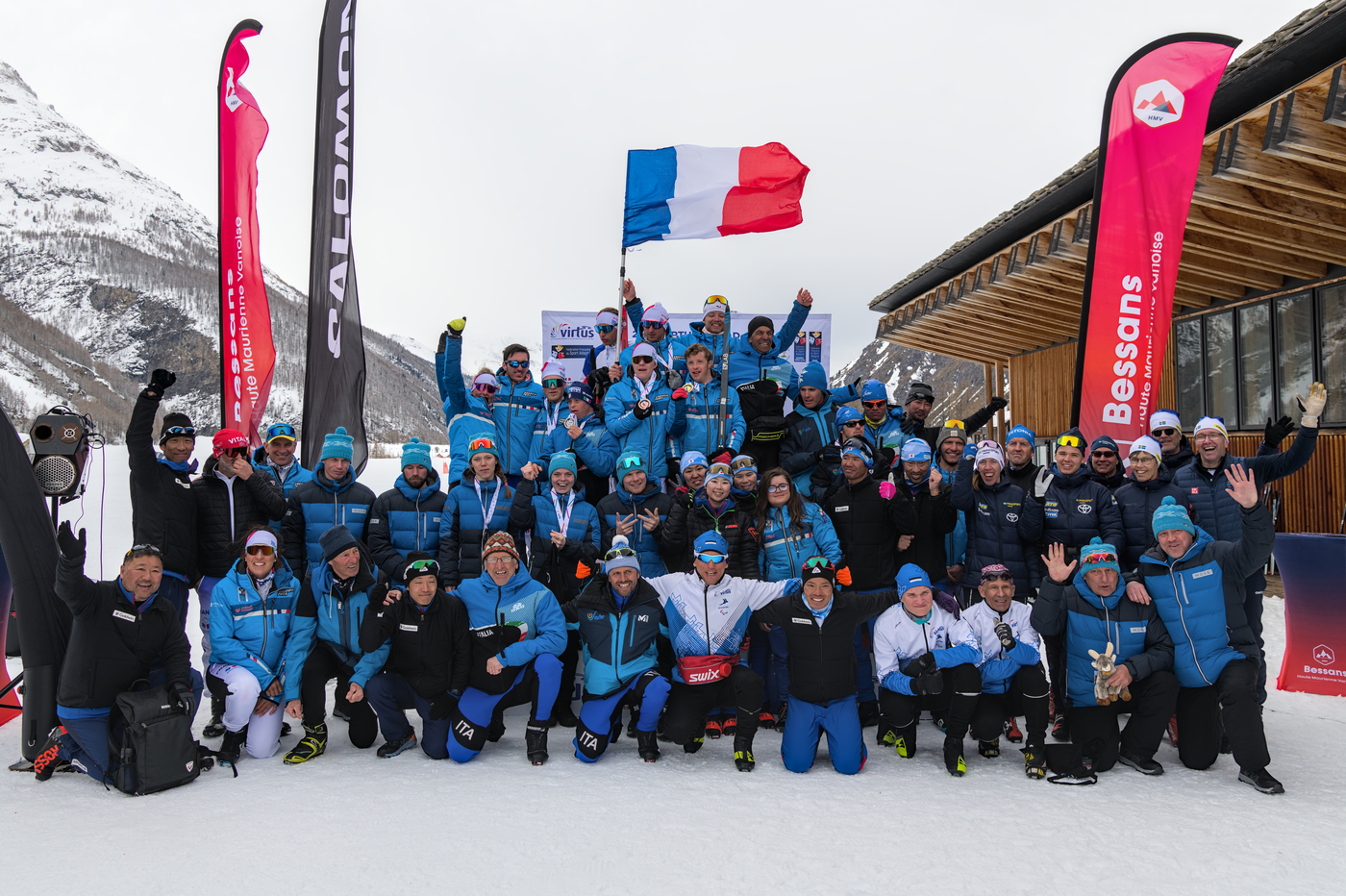
This expertise is also reflected in France’s hosting of major international events, such as the 2023 Global Games in Vichy, the 2025 Virtus World Championships in adapted para alpine skiing in Tignes, and adapted para Nordic skiing in Bessans. Through these events, France has demonstrated its ability to organise competitions of the highest standard, with organisational quality widely praised at the international level.
A driving force behind the “Inclusive Games 2030” statement
Building on its long-standing commitment, the FFSA has naturally positioned itself at the heart of the “Inclusive Games 2030” statement. Alongside athletes, associations, citizens and elected officials, it advocates for a major step forward: allowing Adapted Sport athletes to once again compete at the Winter Paralympic Games—this time at the 2030 Games in the French Alps—after their last participation in Nagano in 1998.
Following the exceptional momentum generated by the Paris 2024 Games and the renewed focus on para sport, this demand is part of a logical continuation: a movement that is not asking for difference, but for recognition.
The athletes exist. The rules exist. The classifications exist. The performances are there—outstanding and undeniable.
All that is missing is a historic decision to allow these athletes to be celebrated on the greatest sporting stage in the world.